Blood Pressure Cuff Size Chart: How to Pick the Right Fit
Measure your upper arm in centimeters and match it to the chart. The wrong cuff can shift a reading by up to 20 mmHg. Here's how to get the right fit.
This article is educational content, not medical advice. Always talk to a healthcare professional about your blood pressure.
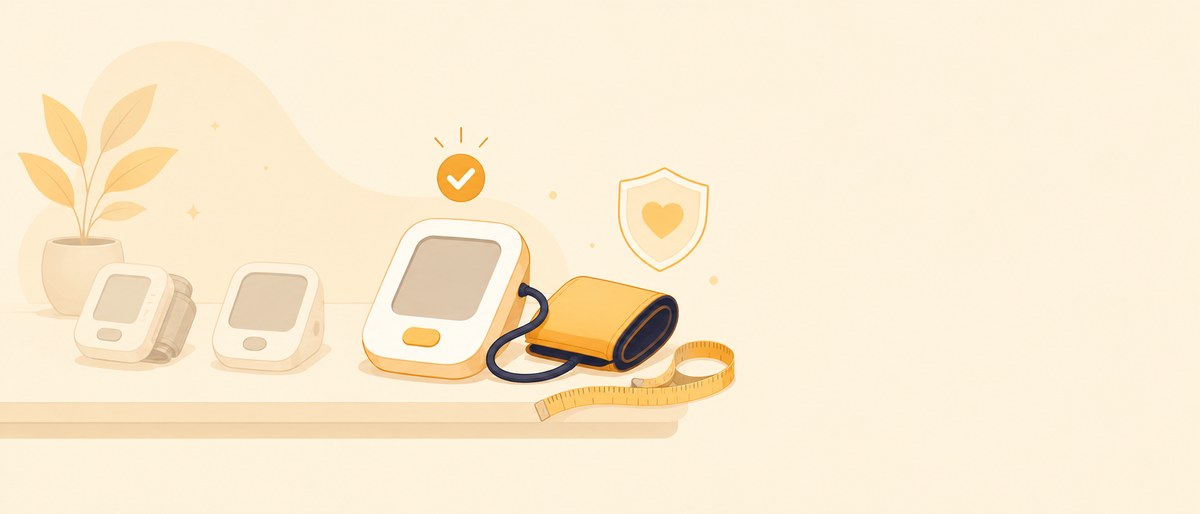
Wrap a tape measure around the middle of your bare upper arm, note the number in centimeters, then match it to a cuff size: 22–26 cm needs a small adult cuff, 27–34 cm a regular adult, 35–44 cm a large adult, and 45–52 cm an extra-large. The "regular" cuff that ships with most home monitors doesn't fit everyone, and using the wrong one is one of the easiest ways to get a reading that's off by double digits.
Cuff size matters more than most people realize. In a randomized trial published in JAMA Internal Medicine, using a regular cuff on people who actually needed a larger one pushed systolic readings up by about 4.8 mmHg for a large arm and 19.5 mmHg for an extra-large arm, while using a regular cuff on a thin arm that needed a small one lowered readings by 3.6 mmHg. The American Heart Association sizes cuffs by the arm's circumference because the inflatable bladder inside has to be roughly 40% as wide and 80% as long as your arm to squeeze it evenly. Get that ratio wrong and the pressure never transfers correctly, so the number on the screen stops meaning what you think it means.
The cuff size chart, by arm circumference
Measure first, then match. These are the ranges the American Heart Association uses in its official measurement guidance:
| Upper arm circumference | Cuff size |
|---|---|
| 22–26 cm (8.7–10.2 in) | Small adult |
| 27–34 cm (10.6–13.4 in) | Regular adult |
| 35–44 cm (13.8–17.3 in) | Large adult |
| 45–52 cm (17.7–20.5 in) | Extra-large adult (adult thigh) |
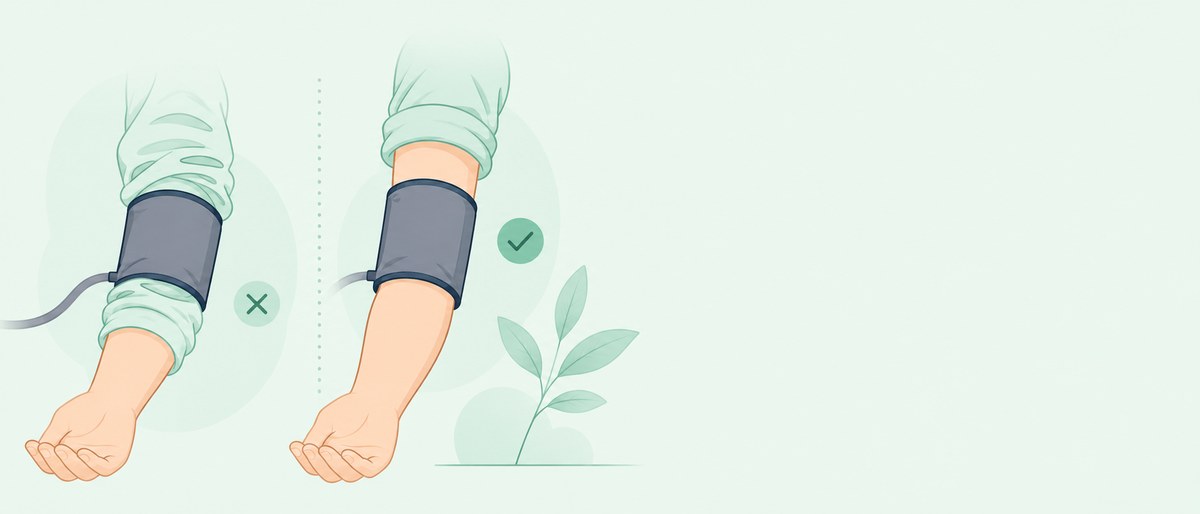
If your measurement lands right on a boundary, most guidance says size up rather than down, since a slightly loose fit skews readings less than a tight one. When in doubt, ask your pharmacist or clinician to check the fit against your arm.
How to measure your arm in 30 seconds
You only need a soft tape measure, or a strip of string and a ruler.
- Bare your upper arm and let it hang relaxed at your side.
- Find the midpoint between the bony tip of your shoulder and your elbow.
- Wrap the tape snugly around that midpoint, level all the way around, without digging into the skin.
- Read the number in centimeters and match it to the chart above.
Measure the arm you'll actually use for monitoring. If your two arms differ by more than a few centimeters, size for the larger one. It's worth doing once a year, or after any big change in weight or muscle, because the cuff that fit last year may not fit now.
Why the wrong size skews your numbers
A cuff that's too small has to work harder to compress a thick arm, so it reports a pressure that's higher than the truth. A cuff that's too large wraps too much of the arm and under-reads. The Cuff(SZ) randomized trial put hard numbers on it:
| If you need this cuff, but use a regular one | Effect on systolic reading |
|---|---|
| Small adult | About 3.6 mmHg too low |
| Large adult | About 4.8 mmHg too high |
| Extra-large adult | About 19.5 mmHg too high |
That last row is the dangerous one. A 19.5 mmHg overestimate can move a normal reading into "Stage 2" territory on paper, which is enough to change a conversation about medication. The same study found a too-small cuff produced falsely high readings in 39% of people who used one. This is exactly the kind of avoidable error good measurement technique is meant to remove.
The "adult" label lies: check the centimeter range
Here's what the box won't tell you. Cuff sizing is not standardized across brands, so one company's "standard" cuff and another's can cover different arm ranges. The American Heart Association has warned that popular home monitors sold with a single one-size cuff may not fit millions of adults whose arms fall outside that range. National survey data backs this up: in a NHANES analysis of US adults, 40% needed a large cuff and another 3% needed an extra-large, so more than 4 in 10 people are poorly served by the regular cuff in the box.
The takeaway is simple. Ignore the word on the label and read the centimeter range printed on the cuff itself, usually near the "index" line and the "range" or "size" markings. When you wrap the cuff on, the end of it should land inside those printed range lines. If it stops short or overshoots, the cuff is the wrong size for you, whatever the box called it.
Keeping your readings consistent once the cuff fits
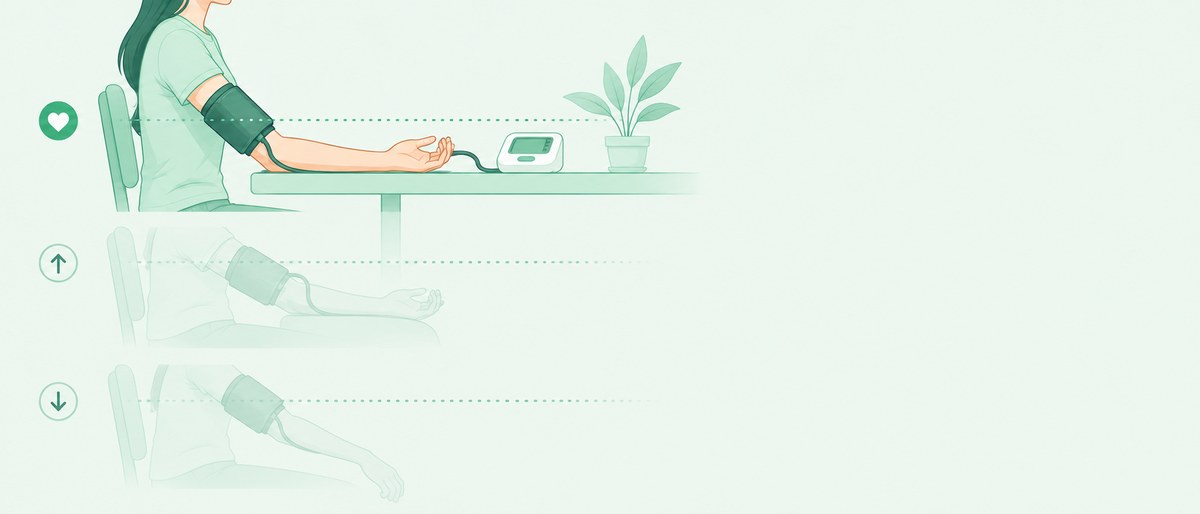
The right cuff only helps if you use it the same way every time. Sit quietly for five minutes first, keep your feet flat and back supported, rest the cuffed arm at heart level, and take two readings a minute apart. Technique and cuff size together are what make a home log trustworthy enough to bring to an appointment. We walk through the full routine in how often to check your blood pressure at home.
Once your monitor and cuff are sorted, the logging is where things usually fall apart. BPlus is built for that part: log each reading in seconds by typing it in or scanning your monitor's display with the camera, and the app stamps the time, date and arm automatically. Your trends build over time, and you can export a doctor-ready PDF or CSV before a visit. Everything stays on your device, with no account required. See the features page for the full list.
FAQ
Does cuff size matter for wrist monitors too?
Wrist cuffs come in their own sizes and are far more sensitive to position, since the wrist has to be held exactly at heart level. Most guidelines still favor a correctly sized upper-arm cuff for home monitoring. If you use a wrist device, follow its own sizing chart and positioning instructions closely.
My arm is between two sizes. Which do I pick?
Size up. A cuff that's slightly too large skews readings less than one that's slightly too tight, and boundary measurements are easy to get a centimeter off. If you consistently land on the edge, ask a clinician to confirm the fit on your actual arm.
Can I just pull the cuff tighter to make a big cuff fit a small arm?
No. The bladder inside has a fixed width and length, and cinching it doesn't change the ratio it needs to your arm. A cuff that's the wrong size stays the wrong size no matter how you fasten it. Match the size to your measured circumference instead.
Sources
- Ishigami J, et al. Effects of Cuff Size on the Accuracy of Blood Pressure Readings: The Cuff(SZ) Randomized Crossover Trial, JAMA Internal Medicine
- Muntner P, et al. Measurement of Blood Pressure in Humans: AHA Scientific Statement, Hypertension
- Jackson SL, et al. Blood Pressure Cuff Sizes for Adults in the United States: NHANES 2015–2020, American Journal of Hypertension
- American Heart Association: Popular home blood pressure cuffs may not fit millions of adults
Keep your readings in one calm place
BPlus does the logging with you: record by hand or scan your monitor, watch your trends, and export a doctor-ready report when you need one.
Medical disclaimer. BPlus is a wellness and informational tool that helps you record, organize and understand your blood pressure readings. It is not a medical device and does not diagnose, treat, cure or prevent any disease. BPlus does not measure blood pressure on its own. Always consult a qualified healthcare professional. Readings are not a substitute for a clinically validated blood pressure monitor.