How Accurate Are Finger and Phone Blood Pressure Apps?
Finger and phone camera apps estimate blood pressure rather than measure it, and the one tested in a study missed most high readings. Use a validated cuff.
This article is educational content, not medical advice. Always talk to a healthcare professional about your blood pressure.
The thresholds on this page follow the ACC/AHA guideline used in the United States (set in 2017 and kept in the 2025 update), which sets high blood pressure at 130/80 mmHg. Other bodies differ: ESH in Europe and NICE in the UK still define it at 140/90 mmHg. Check the guideline your own clinician uses.
Apps that read your blood pressure from a fingertip on your phone's camera or screen aren't accurate enough to rely on. They estimate pressure from your pulse instead of measuring it, and when researchers tested a best-selling one, it told most people with high readings that their pressure wasn't high. For any number you plan to log, share with your doctor, or act on, use a validated upper-arm cuff.
The clearest test so far comes from Johns Hopkins researchers, who compared the Instant Blood Pressure app against validated automated cuffs in 85 adults and published the results in JAMA Internal Medicine in 2016. On average the app was off by 12.4 mmHg for systolic pressure and 10.1 mmHg for diastolic. Worse, about 77.5 percent of people whose cuff showed hypertensive-range pressure (as the study defined it) got an app reading in the nonhypertensive range, so roughly four in five were falsely reassured. For comparison, the American Heart Association's scientific statement on cuffless devices notes that validation standards require, among other criteria, an average error within 5 mmHg. That statement concludes no cuffless technology has yet proven accurate enough for diagnosing or managing high blood pressure.
How do phone and finger apps get a number?
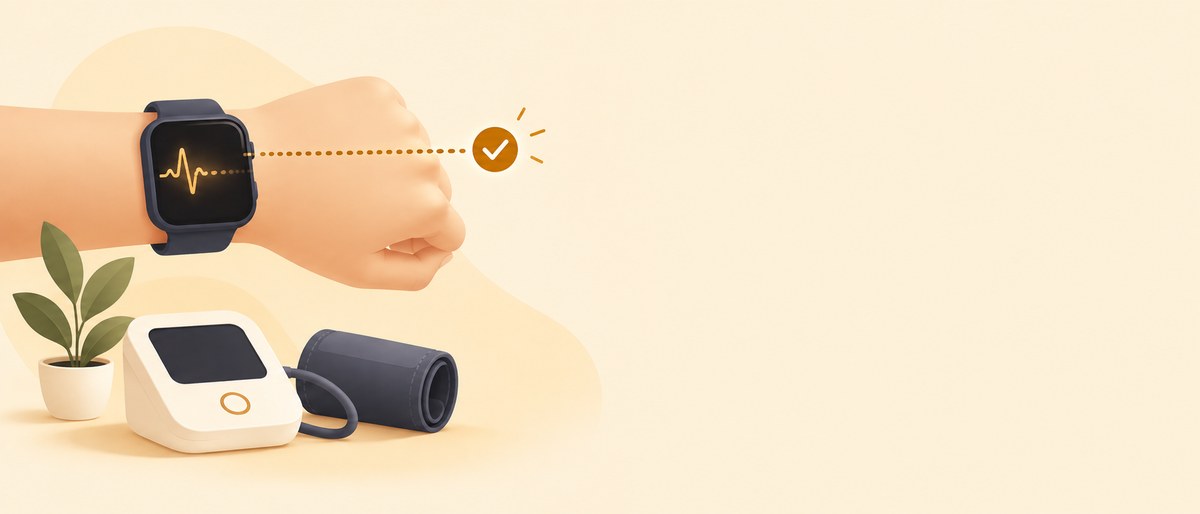
A real blood pressure monitor squeezes your artery with an inflatable cuff and reads the pressure pulses as it releases. A phone has no cuff. So most of these apps point the camera and flash at your fingertip and record tiny color changes as blood pulses through the skin, a method called photoplethysmography (PPG). Software then guesses a blood pressure from the shape and timing of that pulse wave.
The trouble is that a pulse wave reflects more than pressure. Movement and how hard you press can change the signal. The AHA statement lists factors like these among the reasons cuffless estimates drift, and notes that most methods need calibration against a real cuff to produce anything useful at all.
| Approach | What it actually senses | Fit for decisions? |
|---|---|---|
| Finger on phone camera (PPG app) | Color changes in your fingertip | No. An estimate with no cuff behind it |
| Finger pressed on screen or add-on sensor | Pulse plus finger force | Research stage only |
| Smartwatch, optical sensor | Pulse wave at the wrist | Trends at best, needs cuff calibration |
| Validated upper-arm cuff | Pressure in the artery itself | Yes, the standard the others are judged against |
The rule of thumb: if nothing inflates around your limb, you're looking at an estimate.
Already have a cuff? BPlus reads its screen and keeps the log. Scan my monitor →
Does a 10 mmHg error really matter?
A 10 mmHg miss sounds small, but under the ACC/AHA categories it's the full width of the Elevated band and of Stage 1 (other bodies, such as ESH and NICE, draw the bands differently). On that scale, a systolic reading that is really in the Stage 2 range can show up one band lower, and a crisis-level reading could look merely high. The Hopkins data showed this pattern: the app's misses weren't random noise around the right answer. It tended to pull high readings down toward normal, which is the most dangerous direction for an error to go.
There's a second problem. Even a good estimate can't tell you which of your readings is wrong. With a validated cuff you can trust each number within a known margin and then average several readings to smooth out normal variation. With a phone estimate, you don't know whether a change reflects your body or the camera.
What about newer phone methods and research apps?
Researchers haven't given up on the idea. University teams are testing phones with added force sensors, clip-on finger cuffs and camera methods trained on large datasets. The AHA statement treats cuffless measurement as promising but unproven, and it stresses that a method has to pass formal validation in real-world conditions before anyone should rely on it. Lab prototypes also aren't the apps you'll find in an app store.
So the honest answer for 2026 is the same one we gave for smartwatch blood pressure readings: a validated cuff for the numbers that count, and anything else as a curiosity at most.
How to tell if a blood pressure app is trustworthy
Store listings rarely spell out what an app really does, so check these four things before you install:
- Does it ask you to measure, or to enter a measurement? An app that says "place your finger on the camera" is estimating. An app that asks you to type in or scan numbers from your cuff is a log: its numbers are only as accurate as the cuff you measured with.
- Read the fine print. If the listing or the app's disclaimer says it isn't a medical device, or is for reference or entertainment only, take it at its word.
- Look for validation, not marketing. "Clinically accurate" on a product page isn't proof. The check that counts is whether a device passed an independent validation protocol, which you can look up on lists like validatebp.org in the US or STRIDE BP internationally. Our guide to checking a monitor's accuracy explains how.
- Compare it once against a cuff. If you're curious, take a cuff reading and an app reading back to back. A large gap, like the 10 mmHg-plus average error the Hopkins team found, is a clear sign the app can't stand in for a cuff.
If you don't own a cuff yet, our guide to choosing a home monitor covers fit, validation and features. The AHA recommends an automatic, validated upper-arm cuff for home use.
Measure with a cuff, then log it with BPlus
BPlus doesn't measure blood pressure: not with the camera, not with the flashlight, not with your finger.
It's a log for readings you take with your own cuff monitor. Type in your systolic, diastolic and pulse, or point the camera at your monitor's display and let BPlus scan the numbers off the screen.
From there, BPlus sorts each reading into color-coded categories, charts your trends, and exports a PDF or CSV report to bring to appointments. Your data stays on your device, works offline, and needs no account. BPlus is a wellness and logging tool, not a medical device, so it doesn't measure, diagnose or treat anything, and it's no substitute for professional care.
Finger and phone blood pressure apps: FAQ
Can my phone check my blood pressure without a cuff? Not reliably. Phone apps that use your camera or a finger on the screen estimate pressure from your pulse, and the best-known tested app was off by more than 10 mmHg on average (12.4 mmHg systolic in the Hopkins study). The AHA's statement on cuffless devices says none is yet accurate enough for diagnosis or management.
Is it safe to use a finger app just to see if I'm roughly normal? That's the riskiest use. In the Hopkins study, about four in five people with hypertensive-range readings were told they were in the nonhypertensive range. A falsely normal number can delay a conversation with your doctor, so check with a cuff instead.
My phone app and my cuff disagree. Which one is right? Trust the cuff, taken the way the AHA recommends: seated, back supported, arm at heart level, after five minutes of rest. Phone estimates shift with finger pressure and movement. If your cuff readings are consistently high, share them with your doctor.
What if a reading is very high? If you have chest pain, shortness of breath, weakness or vision changes, seek medical help immediately, whatever any device shows. Otherwise go by your cuff: under ACC/AHA guidance, 180/120 mmHg or higher (either number) is a crisis level. Rest a few minutes and measure once more; if it's still that high, seek medical help immediately.
Sources
- JAMA Internal Medicine: Validation of the Instant Blood Pressure Smartphone App (Plante et al., 2016)
- American Heart Association: Cuffless Devices for the Measurement of Blood Pressure (Scientific Statement)
- American Heart Association: Monitoring Your Blood Pressure at Home
- American Heart Association: Understanding Blood Pressure Readings
Medical disclaimer. BPlus is a wellness and informational tool that helps you record, organize and understand your blood pressure readings. It is not a medical device and does not diagnose, treat, cure or prevent any disease. BPlus does not measure blood pressure on its own. Always consult a qualified healthcare professional. Readings are not a substitute for a clinically validated blood pressure monitor.