How Many Blood Pressure Readings Should You Average?
Take 2 to 3 readings a minute apart in one sitting and average them. The single number you see first is often the least reliable. Here's why.
This article is educational content, not medical advice. Always talk to a healthcare professional about your blood pressure.
Take two to three readings, one minute apart, in a single sitting, then average them. That average is your real number, not the first figure the cuff shows. The American Heart Association recommends this because one measurement on its own is too noisy to trust. If your first reading looks high, don't panic and don't stop. Sit still, let the cuff inflate again, and let the average do the work.
The reason comes down to how much blood pressure moves from minute to minute. Two readings taken sixty seconds apart can differ by 5 to 10 mmHg, driven by breathing, a settling heart rate, and simple nerves about the cuff. The 2017 ACC/AHA guideline and the AHA's measurement statement both call for at least two readings a minute apart, averaged, at each session. For a home routine that usually means two readings in the morning and two in the evening. The first reading of a session is often the highest of the group, because your body has not fully settled, which is exactly why no single number gets to stand alone.
The one-sitting rule: 2 to 3 readings, averaged
Within a single measurement session, the protocol is short. Rest quietly for five minutes, feet flat and back supported, then take your readings a minute apart and average them.
| Step | What to do |
|---|---|
| Rest first | 5 minutes seated, quiet, cuff at heart level |
| Reading 1 | Take it, note it, stay still |
| Wait | 1 minute, keep the cuff on, don't talk |
| Reading 2 | Take it, note it |
| If they differ a lot | Take a third reading a minute later |
| Record | The average of the readings |
Two readings is the floor. If your first two differ by more than about 5 mmHg, a third reading gives the average something steadier to lean on. Averaging two numbers is easy math: add the systolic figures and divide by two, then do the same for the diastolic. So 128/82 and 122/78 average to 125/80.
Should you throw out the first reading?
This is where guidance splits, and it's worth understanding both sides rather than picking one blindly. The AHA's plain-language advice is to take your readings and average all of them together. Some research groups go further: because the first reading is so often inflated by the "alerting" response to the cuff, they suggest discarding it and averaging only the second and third. A review in the Journal of Human Hypertension found that dropping the first reading produced a lower, more reproducible average, closer to a person's true resting pressure.
For everyday home tracking, either approach is fine as long as you're consistent. What you should not do is take five readings and keep only the lowest one. Cherry-picking the friendliest number defeats the whole point of averaging, which is to cancel out the noise in both directions.
Three different "how many" questions
Most confusion about this topic comes from mixing up three separate questions that all sound like "how many readings do I need." They have different answers, and this table is the part most guides skip.
| Question | Answer | Why |
|---|---|---|
| How many per sitting? | 2 to 3, a minute apart | Averages out minute-to-minute swings |
| How many per day? | 2 sittings (morning and evening) | Pressure runs higher in the morning for most people |
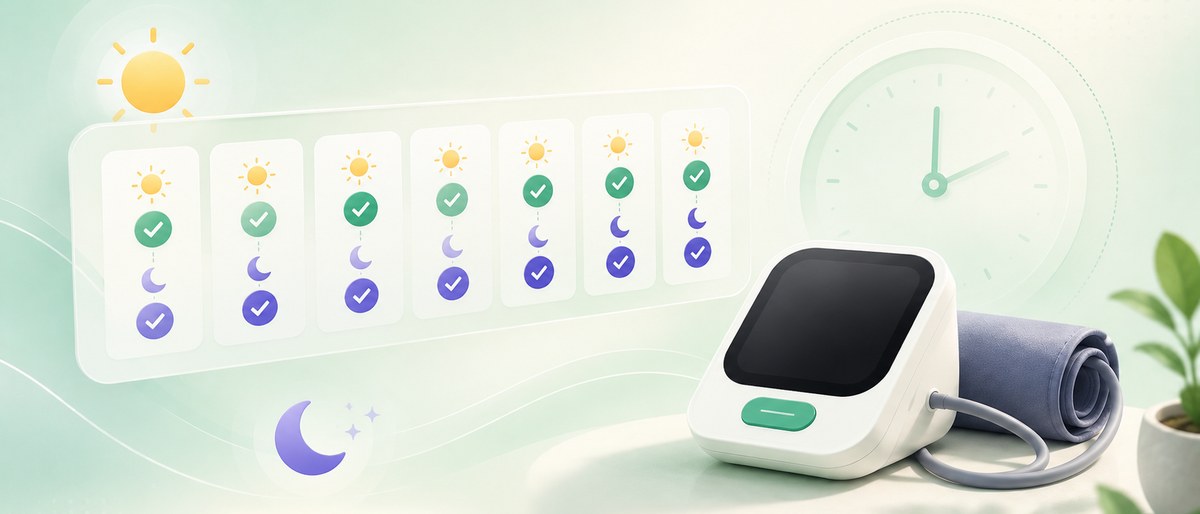
| How many to judge a trend? | About 7 days, roughly 28 readings | A week of data outweighs any single moment |
The first question is about one reliable number right now. The last is about a pattern your doctor can act on. A crisis-level reading is the exception to all of this: if you see 180/120 mmHg or higher, wait a few minutes, measure again, and if it stays there, seek medical help immediately rather than waiting to average.
Why the average beats the single number
A single reading is a snapshot taken at one slightly random moment. The average is closer to the truth because the random pieces cancel out. When clinicians decide anything about blood pressure, they lean on averages across readings and across days, not on the scariest figure someone happened to catch.
This is the same reason readings vary so much between measurements in the first place. Nerves, a recent walk up the stairs, a full bladder, or a held breath can each nudge one reading up. Take three and average them, and no single hiccup gets to define your number. Pair that with measuring at consistent times each day, and one week becomes genuinely comparable to the next.
Keeping the average honest without the mental math
Doing this by hand is where good intentions fall apart. You take two readings, mean to average them, and end up remembering only the one that worried you. That is exactly the failure BPlus was built to remove.
BPlus is a simple wellness and logging tool, not a medical device, and it never measures your blood pressure for you. You still use your own cuff. What it does is capture each reading cleanly: type in the systolic, diastolic and pulse, or scan the display of your own monitor with the camera so the numbers land without typing.
Every entry is stamped with the time, date and arm, and you can add a note like "first reading, felt rushed." From there it charts your trend over time, sorts each reading into the widely used color-coded categories, and exports a doctor-ready PDF or CSV. Because it keeps every reading in the record, your pattern reflects all of them, not just the one you remember. Everything stays on your device, with no account needed, and you can see the full picture on the features page.
Frequently asked questions
Do I really need to average, or can I just take one reading? One reading is fine for a rough check, but it can be off by 5 to 10 mmHg from your true resting pressure. For any number you plan to track or show a doctor, average at least two taken a minute apart. It's a small step that removes a lot of noise.
What if my two readings are very different? Differences of a few mmHg are normal. If they're far apart, you were probably not fully rested, so sit quietly a bit longer and take a third reading. Then average the ones taken after you settled. Large, repeated gaps are worth mentioning to your clinician.
Should morning and evening readings be averaged together? Not into one figure. Keep them as separate morning and evening averages, since blood pressure naturally runs higher in the morning. Your doctor wants to see both parts of the daily rhythm, which is why the standard home routine records each session on its own.
Is the second reading always more accurate than the first? Not always, but it's usually closer to your resting pressure because the first cuff inflation often triggers a brief rise. That's why averaging, or dropping the first reading and averaging the rest, works better than trusting any single measurement.
The short version
For one reliable number, take two to three readings a minute apart in a single quiet sitting and average them. Don't keep only the lowest, and don't let the first, often highest, reading stand alone. For a trend your doctor can use, repeat that morning and evening for about a week. Read the average, not the moment, and if any reading hits 180/120 mmHg or higher and stays there, seek medical help immediately. A steady home log turns those scattered numbers into a pattern worth acting on.
Sources
- Muntner P, et al. Measurement of Blood Pressure in Humans: AHA Scientific Statement: Hypertension (2019)
- Whelton PK, et al. 2017 ACC/AHA Guideline for High Blood Pressure in Adults: Hypertension
- American Heart Association: Monitoring Your Blood Pressure at Home
- Bos MJ, et al. Should the first blood pressure reading be discarded? Journal of Human Hypertension (2015)
Keep your readings in one calm place
BPlus does the logging with you: record by hand or scan your monitor, watch your trends, and export a doctor-ready report when you need one.
Medical disclaimer. BPlus is a wellness and informational tool that helps you record, organize and understand your blood pressure readings. It is not a medical device and does not diagnose, treat, cure or prevent any disease. BPlus does not measure blood pressure on its own. Always consult a qualified healthcare professional. Readings are not a substitute for a clinically validated blood pressure monitor.