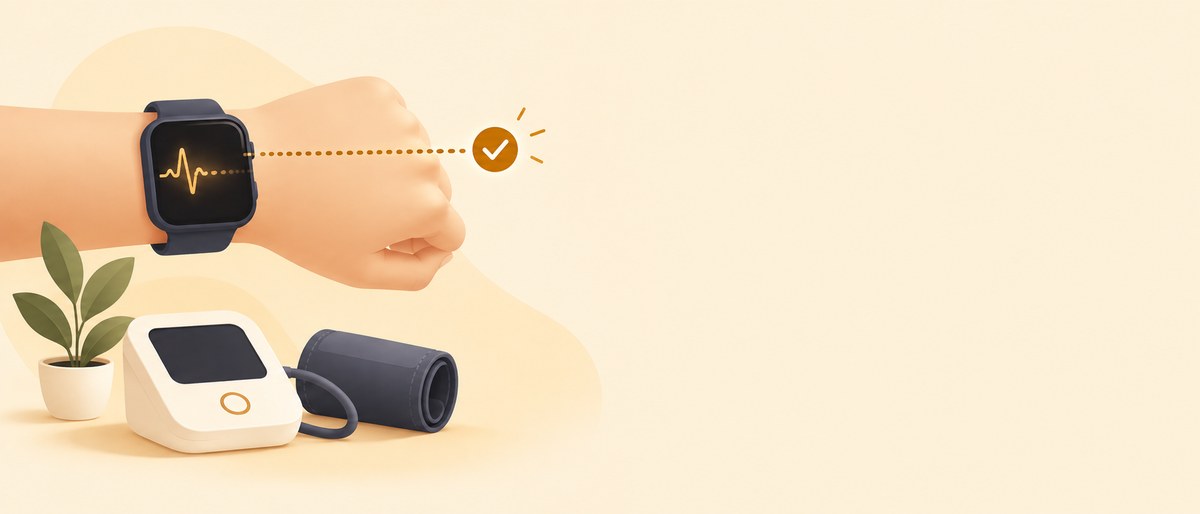
Wrist vs Upper Arm Blood Pressure Monitor Accuracy
Upper arm blood pressure monitors are more accurate than wrist ones, which is why the AHA recommends them. Wrist readings shift with hand position and height.
This article is educational content, not medical advice. Always talk to a healthcare professional about your blood pressure.
Upper arm monitors are the more accurate choice, and they are what the American Heart Association recommends for home use. Wrist monitors can work, but only when held at exactly the right height, because a wrist sits far from your heart and its reading changes with the smallest shift in position. If you want one device you can trust reading after reading, pick an automatic cuff that wraps around your upper arm.
The gap comes down to where the measurement happens. The American Heart Association advises an automatic, cuff-style, upper arm monitor and specifically says wrist and finger monitors are not recommended for most people because they tend to be less reliable. The reason is physical. Blood pressure rises the further a measurement point sits below heart level, so a wrist resting in your lap reads higher than the same wrist raised to your chest. Arteries at the wrist are also narrower and closer to bone, which makes them harder for a cuff to read cleanly. An upper arm cuff sits naturally near heart height over a large artery, so it removes most of that positioning error before it starts.
Which is more accurate, wrist or upper arm?
Upper arm wins on accuracy for almost everyone. Both types use the same oscillometric method, sensing the pulses of blood through the artery under the cuff, so the technology is not the problem. Position is. Mayo Clinic notes that wrist monitors are very sensitive to body position, and to get an accurate reading your arm and wrist have to be at heart level. Get the height wrong and the number drifts, which is why the same wrist device can hand you two very different results minutes apart.
Here is how the two compare on the things that actually matter at home.
| Factor | Upper arm monitor | Wrist monitor |
|---|---|---|
| Accuracy | Highest; AHA recommended | Good only with perfect positioning |
| Position sensitivity | Low, cuff sits near heart | High, small height changes shift the reading |
| Ease of use | Cuff can be fiddly one-handed | Quick to put on |
| Best for | Everyday tracking for most people | Very large arms, arm pain, cuffs that will not fit |
| Portability | Bulkier | Compact and travel-friendly |
Why do wrist readings go wrong so easily?
The wrist's distance from the heart is the whole story. Every centimeter the wrist drops below heart level nudges the reading up, and every centimeter above it nudges the reading down, so resting your hand on a table or in your lap can inflate the number without you noticing. Cleveland Clinic explains that this height sensitivity, plus the smaller arteries at the wrist, is why home wrist readings are often falsely high and why clinicians lean on upper arm devices instead.
Research backs this up. A study of home wrist self-measurement published in the AHA journal Hypertension found wrist readings were poorly reliable compared with a validated upper arm reference, enough that the authors cautioned against relying on them for diagnosis or management. The takeaway isn't that wrist monitors are useless. It's that they demand a level of positioning care most people can't repeat perfectly every single time.
When does a wrist monitor make sense?
There are real cases where a wrist monitor is the better tool. If a standard upper arm cuff won't fit or is painful, a wrist device can be far more comfortable and still useful for tracking your own trend over time. Common reasons people choose one:
- A very large upper arm where even the biggest cuff does not fit properly
- Arm or shoulder pain, lymphedema, or another reason a squeezing arm cuff is uncomfortable
- Frequent travel, where a compact device is easier to pack
If you go this route, treat technique as non-negotiable. Rest your elbow on a table, support your forearm, and raise the wrist so the device sits level with the middle of your chest. Getting a cuff that fits your arm is the other half of accuracy, and our guide to choosing the right cuff size covers why a loose or tight fit skews the number as much as the wrong device can.
How to get the most accurate reading from either type
Whichever monitor you own, the same routine protects the number. Sit with your back supported and feet flat, rest for five minutes, keep quiet, and place the cuff on a bare arm. For an upper arm monitor, rest your arm on a table so the cuff is at heart height. For a wrist monitor, the extra step is raising and supporting the wrist to that same level. Our full checklist for an accurate reading at home walks through every step so device choice is not the only thing you are getting right.
Whatever the reading, one number always overrides the wrist-versus-arm debate. The American Heart Association treats a result at or above 180/120 mmHg as a hypertensive crisis. If your reading is that high and stays there after a few minutes of rest and a repeat, or you have symptoms like chest pain or trouble speaking, seek medical help immediately.
Once you have a monitor you trust, the value is in the pattern over weeks, and that is where BPlus helps. You log each systolic, diastolic and pulse reading by hand, or scan your monitor's display with the camera so the numbers go in without typing, and the time, date and arm are stamped for you. Note which device or wrist you used, watch the trend chart build, and let the app sort each entry into the standard categories. BPlus keeps everything on your device, works offline and needs no account. It is a wellness and logging tool, not a medical device: it does not measure, diagnose or treat blood pressure, and it is no substitute for professional care. What it does is turn a drawer full of scattered readings into a clear record you and your doctor can actually read.
Mini-FAQ
Are wrist blood pressure monitors ever accurate? They can be, but only with careful positioning. The wrist has to be held at heart level and kept still, and even then the American Heart Association prefers upper arm cuffs for most people. If you use a wrist device, check it against a clinic reading so you know how your numbers line up.
Why is my wrist reading higher than the doctor's? Position is the usual reason. If your wrist sat below heart level during the reading, blood pressure at that point is naturally higher, so the device reports a raised number. Redo the reading with your wrist supported at chest height and the gap often shrinks.
Does the AHA recommend wrist or upper arm monitors? The American Heart Association recommends an automatic, cuff-style, upper arm monitor and does not recommend wrist or finger monitors for routine home use, because upper arm readings are more reliable. Wrist devices are a fallback for people who cannot use an arm cuff comfortably.
Can I switch between a wrist and an arm monitor? It is better to stick with one so your readings stay comparable, since the two can differ. If you must use both, label each reading with the device used and compare trends within the same device rather than jumping between them day to day.
Sources
Keep your readings in one calm place
BPlus does the logging with you: record by hand or scan your monitor, watch your trends, and export a doctor-ready report when you need one.
Medical disclaimer. BPlus is a wellness and informational tool that helps you record, organize and understand your blood pressure readings. It is not a medical device and does not diagnose, treat, cure or prevent any disease. BPlus does not measure blood pressure on its own. Always consult a qualified healthcare professional. Readings are not a substitute for a clinically validated blood pressure monitor.