Which Arm Should You Use to Take Blood Pressure?
Measure both arms the first time, then use the arm with the higher reading for every check after. A gap over 10 mmHg is worth telling your doctor.
This article is educational content, not medical advice. Always talk to a healthcare professional about your blood pressure.
Check both arms the first time you measure, then use the arm that read higher for every reading after that. Blood pressure often differs a little between your two arms, and the American Heart Association advises picking the higher-reading arm so you don't quietly underestimate your numbers. Once you know which arm that is, stay with it. Consistency is what makes home readings comparable week to week.
Most people assume there is one "correct" arm, usually the left, and stick to it out of habit. The American Heart Association actually recommends measuring both arms at your first assessment, then using whichever arm gives the higher reading for ongoing monitoring. A small side-to-side difference is normal and reflects how the arteries branch off the aorta. A difference under about 5 mmHg is common and unremarkable. A consistent systolic gap of 10 mmHg or more is different: research in the AHA journal Hypertension treats 10 mmHg as the upper limit of normal, because larger gaps are linked to higher cardiovascular risk and can point to narrowed arteries on one side.
Do a one-time both-arms check
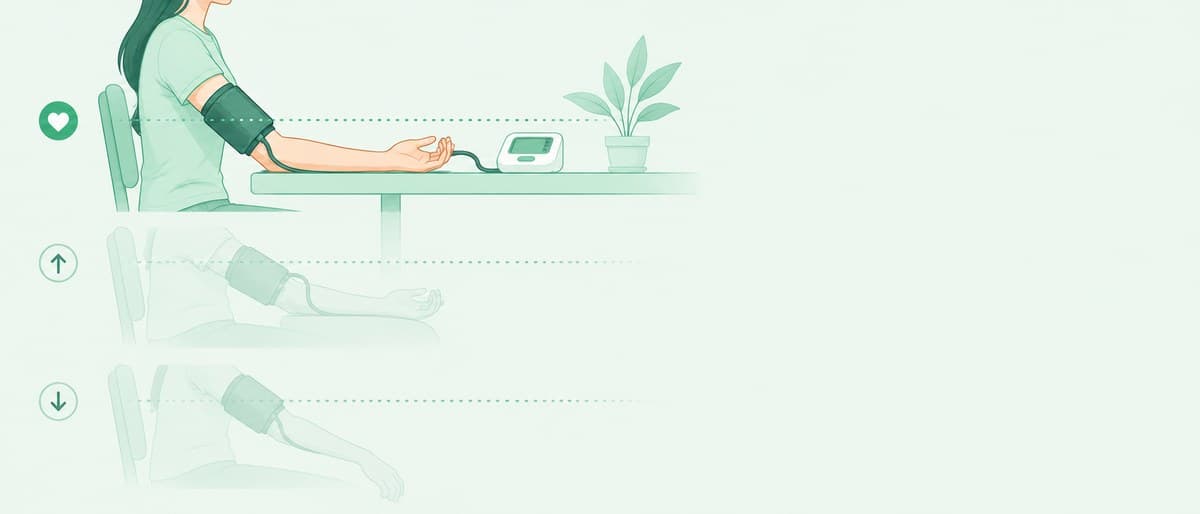
You only need to compare arms once, not at every session. Set aside five minutes and follow your normal routine: sit with your back supported, feet flat, and the cuffed arm resting on a table at heart level. Take a reading on one arm, wait a minute or two, then measure the other arm the same way. If you can, repeat once more on each side and compare the averages rather than single readings, since a single measurement can be off for reasons that have nothing to do with your arms.
Whichever arm reads higher becomes your everyday arm. Write it down so you and anyone helping you use the same side each time. If the two arms are within a few points of each other, either arm is fine, but it still helps to choose one and be consistent.
What the difference between arms actually means
The gap between your arms is called the interarm difference, and its size carries meaning.
| Systolic difference between arms | What it usually means |
|---|---|
| Under 5 mmHg | Normal variation, seen in most people |
| 5 to 9 mmHg | Still within the common range; keep using the higher arm |
| 10 mmHg or more (repeated) | Above the normal limit; mention it to your doctor |
| 15 mmHg or more (repeated) | Larger gap tied to higher cardiovascular risk |
These thresholds come from AHA guidance and pooled research. A large analysis published in Hypertension found that a systolic interarm difference of 10 mmHg or more is associated with a greater risk of cardiovascular events, and the risk climbs as the gap widens. Assessing both arms reclassifies blood pressure in roughly 1 in 10 people, which is the whole reason the both-arms check exists. A one-off 10-point gap is not a diagnosis, though. What matters is a difference that shows up repeatedly across separate sessions, so confirm it on another day before you read anything into it.
Is the right arm or the left arm higher?
There is no fixed rule, which is exactly why you measure instead of assume. In many people the right arm reads slightly higher because of how the subclavian artery branches from the aorta, but this is a tendency, not a guarantee, and plenty of people run higher on the left. Guessing based on which hand you write with, or which arm is "usually" higher, defeats the purpose. The two-minute comparison tells you the truth for your own body, and that beats any general rule.
Why staying on one arm matters
Switching arms between readings adds noise you can't see. If your right arm runs 8 mmHg higher and you measure it on Monday and your left arm on Thursday, part of the change you record is just the arm, not your actual blood pressure. Sticking to the higher-reading arm removes that variable and keeps your trend honest. It also errs on the safe side: using the higher arm means you are less likely to miss elevated readings that the lower arm would have masked. Arm choice is one of several small habits that keep home numbers steady, alongside correct arm position and a settled body before you start. If your readings still bounce around, our guide to why readings vary covers the other usual suspects.
Frequently asked questions
Should I always use my left arm? No. The left arm is a common default, but it is not automatically the right choice. Compare both arms once, then use whichever reads higher. For many people that turns out to be the right arm, but you cannot know without checking, so measure rather than assume.
How different can my two arms be before it's a problem? A difference under 5 mmHg is normal. A repeated systolic gap of 10 mmHg or more is above the usual limit and worth mentioning to your doctor, and 15 mmHg or more is linked to higher cardiovascular risk. One reading is not enough to judge; confirm the gap on a separate day first.
Do I need to check both arms every time? No. The both-arms comparison is a one-time step to find your higher arm. After that, use the same arm every time. You only need to recompare if a clinician measures a new difference or advises you to recheck.
Which arm do clinics use? A careful clinic checks both arms at a first visit, then uses the higher-reading arm afterward, the same approach recommended for home monitoring. If your provider has told you one arm reads higher, use that arm at home too.
Where BPlus fits in
Once you know your arm, the next job is keeping the numbers organized, and that is where BPlus helps. BPlus is a wellness and logging tool, not a medical device, and it never measures your blood pressure. You take the reading with your own cuff monitor, then log it.
Type in the systolic, diastolic, and pulse, or scan your monitor's display with the camera so the numbers land without typing. Every entry is stamped with the time, date, and arm automatically, so you can see at a glance that you have stayed on the same side, and you can add a note like "right arm, higher side." The app charts your trend, sorts each reading into the widely used color-coded categories, and exports a doctor-ready PDF or CSV. Everything stays on your device with no account required. See the full picture on the features page, or read our routine for taking an accurate reading at home.
The short version
Compare both arms once, then use the arm that read higher for every check from then on. A side-to-side difference under 5 mmHg is normal, while a repeated systolic gap of 10 mmHg or more is worth raising with your doctor. Stick to one arm so your trend reflects your blood pressure and not which side you happened to use. And if a home reading ever reaches 180/120 mmHg or higher and stays there after you re-check, seek medical help immediately.
Sources
- American Heart Association: Measurement of Blood Pressure in Humans (Scientific Statement)
- American Heart Association News: Are you taking blood pressure in both arms? You should, study finds
- Clark CE, et al. Associations Between Systolic Interarm Differences in Blood Pressure and Cardiovascular Disease Outcomes and Mortality: Hypertension (2021)
- Harvard Health: Blood pressure checks, both sides now?
Keep your readings in one calm place
BPlus does the logging with you: record by hand or scan your monitor, watch your trends, and export a doctor-ready report when you need one.
Medical disclaimer. BPlus is a wellness and informational tool that helps you record, organize and understand your blood pressure readings. It is not a medical device and does not diagnose, treat, cure or prevent any disease. BPlus does not measure blood pressure on its own. Always consult a qualified healthcare professional. Readings are not a substitute for a clinically validated blood pressure monitor.